A practical house number size guide starts with your local bylaw, then asks whether responders and guests can read the digits from the road. Canadian cities set their own minimums. There is no single federal height chart. Below are Winnipeg, Toronto, and Vancouver examples, common fire-code practice, and how our team builds powder-coated steel numbers for Canadian homes.
Winnipeg house number rules
The City of Winnipeg street address number rules say the address number on each principal building must be clearly visible from the street. Building numbers must be at least 8 cm (3 inches) high, and the colour should contrast with the structure. When a property sits beside a back lane, the number must also be attached so it is visible from that lane.
Those are compliance minimums. Longer driveways and winter light often push homeowners toward larger digits than the bylaw floor.
Fire-code visibility practice (not Winnipeg’s 3-inch minimum)
The NFPA summary of premises identification in NFPA 1 notes that address numbers must be visible from the street, may sit on the building or on a street-side post if the building is hidden, should contrast with the background, and should be large enough to read from the road. NFPA 1 leaves much of the numeric sizing to the authority having jurisdiction.
International Fire Code–style handouts used by some fire prevention offices call for characters at least 4 in (101.6 mm) high with a 0.5 in (12.7 mm) stroke, plainly legible from the street. That is IFC-style practice. Winnipeg’s written minimum stays 8 cm / 3 in. A U.S. IFC chart is not Manitoba law.
Setback-based size examples from other Canadian cities
Toronto’s Municipal Code Chapter 598 scales residential minimum number height with setback from the curb or roadway edge: within 15 m, 0.10 m (100 mm); 22.5 m, 0.15 m; 30 m, 0.20 m; 45 m, 0.30 m; 60 m, 0.40 m, with numbers facing the street that provides primary access (see the Toronto numbering bylaw PDF).
Vancouver’s Building By-law example table uses contrasting backgrounds and non-illuminated character sizes by setback (about 100 mm at 0–15 m, 150 mm at 15–20 m, 200 mm beyond 20 m). If landscaping hides the building, Vancouver can require a property sign displaying the street number (sign ≤0.4 m²).
Calgary’s Addressing Bylaw requires numbers displayed conspicuously so they are plainly visible from the adjacent roadway, and from the lane when the property has lane access.
Distance charts some fire departments publish
Some fire jurisdictions publish approved visibility tables by distance to the public way. One IFC-style example uses 4 in at 0–50 ft, 6 in at 51–100 ft, 8 in at 101–150 ft, 10 in at 151–200 ft, and 12 in beyond 200 ft. Those charts are emergency-visibility practice from a specific AHJ. They are not a Canada-wide size law.
FireSmart Canada also advises clearly marking your address so responders can find the home, and keeping access routes clear of vegetation that would block a fire truck, as noted in the FireSmart Begins at Home Guide (PDF).
Placement tips that keep numbers readable
- Face the number toward the main street approach (and the lane if your bylaw requires it).
- Use contrast: dark on light, or light on dark brick or siding.
- Keep shrubs, wreaths, and seasonal decor clear of the digits.
- On long rural approaches, plan a second marker at the entrance when the building is hard to see from the road.
- Prefer Arabic numerals sized to your bylaw; decorative street names are optional extras unless a local sign rule limits wording.
How Bear Country Metalworks builds house numbers
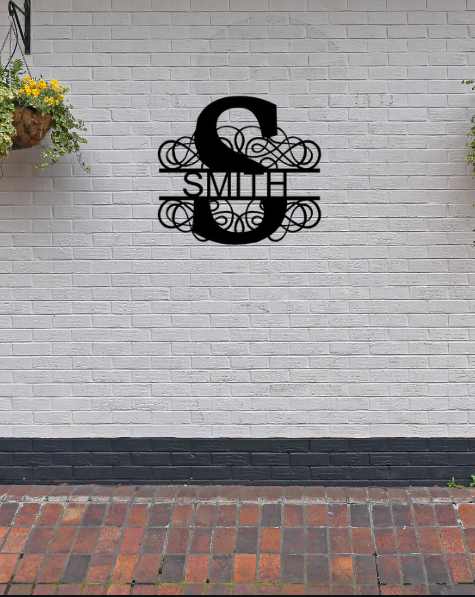
Our metal house numbers, address plaques, and custom metal address signs are cut from 12-gauge mild steel and powder-coated for outdoor use. We rate that powder coat for about 20 years in direct UV. That is a Bear Country Metalworks product rating for these steel signs, not an independent AAMA or lab warranty.
You review a design proof before we cut. Proofs typically come back in about 3 days. After you approve and pay, orders usually reach the door in about 3–4 weeks. Shipping is free across Canada.
FAQ: house number size and placement
What is the minimum house number height in Winnipeg?
At least 8 cm (3 inches), contrasting colour, clearly visible from the street, and from the back lane when the property is adjacent to one.
Is there one size chart for all of Canada?
No. Rules are municipal. Toronto and Vancouver publish setback-based tables; Winnipeg uses a fixed minimum height. Always check your city or rural municipality.
Should I follow a 4-inch fire-code rule in Manitoba?
IFC-style practice often cites 4 in characters with a 0.5 in stroke. Winnipeg’s written minimum is 3 in / 8 cm. Use the larger size if you want extra curb visibility, but cite your own bylaw for compliance.
Do powder-coated steel numbers work outdoors?
Our outdoor signs use 12-gauge mild steel with a powder coat we rate for about 20 years in direct UV as a product rating. Protect the finish from chips down to bare metal.
Can I add a street name on the same piece?
Municipal bylaws usually care about the visible number. A plaque that also shows the street name is a design choice. Browse address plaques and address signs if you want both.
Shop related: Explore our metal house numbers collection, address plaques, address signs, and custom house signs.