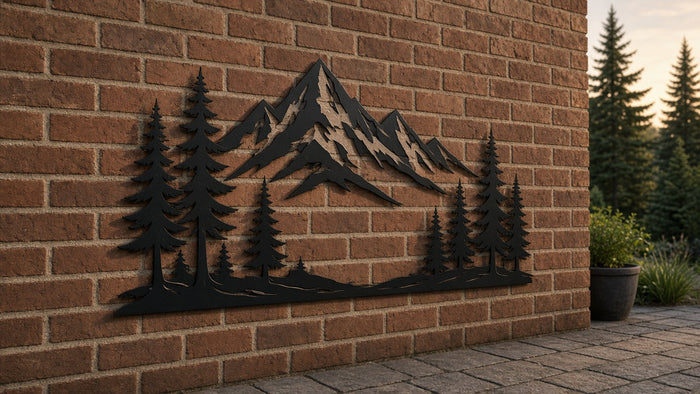
Deck privacy panels and railing inserts can screen a neighbour’s view or dress an open rail, but they sit inside a larger guard system. Canadian residential practice follows National Building Code ideas that provinces adopt with local amendments. Here is when guards are required, typical heights and opening limits, how inserts relate to post-and-rail systems, and how our 12-gauge powder-coated steel panels fit as decorative pieces.
When decks need a guard under NBC-aligned practice
A Southwest New Brunswick Service Commission summary of NBC-based guard heights (PDF) says guards are generally required when there is a height difference of 60 cm (about 24 in) or more. Exterior residential guards are often a minimum of 90 cm (about 36 in) when the walking surface is not more than 1.8 m above grade, and a minimum of 107 cm (about 42 in) when the drop is more than 1.8 m. Openings should not allow a 10 cm sphere to pass. Confirm the edition and amendments your building department applies.
BC Building Code exterior guard heights (example)
The BC Building Code 2018 Division B Section 9.8 excerpt states that, except as provided, guards shall be not less than 1 070 mm high; within dwelling units, not less than 900 mm; and exterior guards serving not more than one dwelling unit not less than 900 mm where the walking surface is not more than 1 800 mm above finished ground level. Manitoba and Winnipeg adopt NBC concepts with their own amendments, so treat BC figures as a clear published example and verify locally.
Infill panels vs the structural rail
Ontario Supplementary Standard SB-7 describes a post-and-rail system where the top rail transfers loads to vertical posts anchored through the floor system, and the space between posts is infilled with pickets or panels. The City of Kingston SB-7 deck-guard guide (PDF) explains that post spacing is dictated by the posts’ ability to accept design loads, not by decorative panel preference.
Railing inserts occupy openings between posts and rails as part of a guard assembly. They are not a substitute for required guard height, post anchorage, or top-rail continuity. Privacy-oriented panels may screen more than open pickets, but when they serve as guard infill they must still meet opening-size and load rules from the applicable code.
Privacy panels, railing inserts, and fence toppers
- Privacy panels and screens cover more of a bay or fence span to block sightlines.
- Railing inserts are decorative panels sized to sit inside an existing rail frame (exact W×H is listed on each product; many inserts are about 3 ft high).
- Fence toppers dress the upper span when you do not need a full-height screen.
Our team builds 12-gauge powder-coated steel panels. They are finish pieces that fit a frame planned for code. A decorative insert alone does not satisfy guard load or climbability rules.
Coating notes for outdoor steel panels
AAMA 2603 / 2604 / 2605 performance classes are written for coatings on architectural aluminum. Industry finishing literature notes there are no AAMA specifications for steel substrates, even when architectural powders are used on steel. We rate our powder-coated mild steel outdoor pieces for about 20 years in direct UV. That is a Bear Country Metalworks product rating, not an AAMA steel certification.
Personalized sizes get a proof in about 3 days. After approval and payment, delivery is typically about 3–4 weeks to the door, with free shipping in Canada. Browse decorative deck panels and railing inserts and fence toppers for listed sizes.
FAQ: deck privacy panels and railing inserts
Do decorative railing inserts make my deck code-compliant?
No. Inserts are decorative panels that fit within a rail frame. Height, openings, loads, and post connections still need to meet local code.
What guard height should I plan for?
NBC-aligned summaries often use about 90 cm up to 1.8 m above grade and 107 cm above that. Confirm with your local building department.
How large can openings be?
Many residential rules limit openings so a 10 cm (about 4 in) sphere cannot pass. Patterned metal still has to respect that limit when it is part of the required guard.
What steel do you use?
Our panels are 12-gauge powder-coated steel with exact width and height listed on each product page.
Can solid privacy panels increase wind load on a rail?
Solid panels catch more wind than open pickets. There is no one wind multiplier that fits every yard, so ask an engineer or your building official when you plan solid infill in an exposed location.
Shop related: See metal fence privacy panels and screens, fence toppers, and home decor.